Thursday, July 7, 2011

Voices


Last month I was asked to write a post for my friend Heather. She was doing a list of her favorite not-so-famous authors in a list of writers from A-Z on her blog Proud Book Nerd. I was happy to do it, but now that it has been a while, and because I am lazy, I thought I would share that post here. At least this way I will know where a copy of it is. Check out Heather’s site and her great list of authors you might not have heard of (yet.) And now the post…

Although I still suffer from chronic depression, I don’t hear the voices anymore. This is what a man actually said to me at one of my first book signings. He stopped, turned over one of my books, nodded, and then gave me this gift—the first line for a book I hope to one day write.

I collect first lines, sentences that people throw away not realizing their worth. Once while driving my son and his friends home from a trip to the video game store, one of the kids in the back seat said, “I’m the world’s most unluckiest person; whenever I throw something in the trash, I miss.” I kept repeating that in my head until I could find pen and paper. For a writer it’s like finding a twenty on the sidewalk.

Lately it feels more like I’m becoming a hoarder. I’m a fantasy writer and these sentences lend themselves more to literary fiction, or clever short stories filled with porch swings, estranged brothers, and the ghost of a childhood dog or perhaps a goldfish. I don’t do much of that. I write about sword swings, strange brotherhoods, and ghosts of wizards or perhaps a goldfish. When you think about it ghostly goldfish are just one of those things that work anywhere.

The point is that I keep these things in files and notebooks but never use them. I take them out occasionally. I look at them like jewelry and try them on the way a widow might while thumbing through photo albums with yellowed pages. They are the keys to a car I don’t drive anymore. It lies under a tarp in the garage and quite frankly, I’m not even sure it will even start. Still, I remember the way it used to roar once upon a time, and how it ate the open road. And the road was open back then, back before I was published.

I’m not lamenting getting published, that’s like cursing about dying and going up instead of down—but it does close doors. They aren’t locked. I could force a few open if I worked really hard, but that’s the thing. After struggling for decades to get to the mountain, it’s hard to even think of hiking another. But you see, I never intended to be a fantasy author. I guess I never intended to be any kind of author. I never knew there was a choice. I assumed it was more like a buffet and you could go up for seconds and thirds. The first trip is really just to taste stuff anyway, to see what you’ll load up on the second trip. Only it doesn’t work that way. Once you leave the runway and the landing gear is up there isn’t much going back. I established a fan base of people who like what I wrote—not what I might want to write. After forcing them to develop a taste for light-hearted adventure, I expect they will be peeved if my next novel is about the tormented mind of a serial killer driven crazy in contemporary Detroit. Maybe he’s the one with the ghostly goldfish—a fishy Caesar, who decides who dies like a less humorous, less corporal, Audrey II.  

Instead I need to play to the audience I made. I entered into a contract with them, a contract I didn’t know about until after I signed. I mean honestly, who knew that when I was bored one day and started writing a nutty, medieval, six-act opera about a self-serving thief and an idealistic soldier that it would be the one. I wasn’t even taking it seriously. I didn’t care. I had written dozens of books and even more unfinished beginnings that went nowhere. This was no different. But it was, and now I look back across the piles of science fiction, horror, mysteries, and coming of age tales, and I take out my first sentence jewels and put them on. I glance at myself in the mirror and wonder what might have been.

Back in the drawer they go, and the albums fold and slide away. Like I said I don’t regret being published, but it closes doors that once were open; doors through which blew exotic breezes. Winds from distant lands where I will never venture and over seas I shall never sail.

Although I still suffer from chronic depression, I don’t hear the voices anymore.

My problem is that I still hear the voices.    


Sunday, July 3, 2011

Writing Advice 3—Outlining


To outline or not to outline, this is an old debate in the writing world. Some writers insist on outlining, while others declare outlining is unnecessary, and perhaps even limiting. I was on a writer’s panel at a convention recently where one writer declared that if they were to outline the story they would know what was going to happen, and if they knew that, there would be no fun in writing it anymore. They also mentioned that they could not write a mystery novel to save their soul, even when challenged to do so. These two statements should tell you a lot about outlining, the pros and cons, and whether it is right for you.

What is outlining? Simply put, it is plotting ahead, figuring out where the story will go in advance of writing it. As novels are usually long and involved things, and most of us don’t have perfect recall, we write notes to ourselves. This is an outline. Outlines, and outlining methods, vary considerably from simple vague sketches to the analytically detail-obsessed straightjacket type. In other words, some have a handful of bullet points necessary to form the story, and others list in specifics everything that will happen in each chapter, almost like Cliff notes.

If you find yourself in the mood to write a story, you don’t want to spend hours, weeks, or even months planning the whole thing out first. That sounds far too much like work instead of fun. Most people just want to sit down and start hammering out what’s in their head. It is like deciding to go to the beach on a hot Saturday afternoon. You just want to throw on a bathing suit and go, you don’t want to stop to pack a blanket, towel, sunscreen, a cooler of drinks, lunch, sandals, sunglasses, etc. The result is that you get to the beach right away and you can immediately start enjoying the day.

After ten minutes you realize a blanket and towel would really have been a good idea, as would a cold drink but it’s too late now, you’re already there and it would be so much more trouble to leave and then come back. After a half hour you realize how much your friends would have liked this. Most of them work on Saturday. Of course if you had planned ahead, if you had mentioned it to them a week ago, they could have gotten off work. Better yet, if you had planned this two months ago, you could have rented a beach house with all your friends for the whole weekend. You could have stocked it with food and drink and reggae music. So as you sit alone on the naked sand feeling your skin burn thinking about all the things you could have done if you had spent a little prep time, you realize being at the beach isn’t as much fun as you expected. Instead you start thinking about how much fun going out to dinner would be. So you pack up and leave, forgetting all about the beach and chalking it up as another failure.

Translated in terms of novel writing, you get a few thousand words into the story, don’t know where to go next, lose interest, and then another idea for a different story hits you and you dump the old one, only to repeat the same mistake.

So you should always outline, right?  

Ever known a person who doesn’t know the word spontaneous? Who can’t do anything without planning each step? The idea of going to the beach for them is too exhausting to even think about, but if they manage it, it won’t matter that they are giving free parasailing rides right in front of them, taking advantage of this is unthinkable because it wasn’t planned for. This type of person, even if they have a week to prepare, won’t have enough time. What if they get sick? Should they bring aspirin? Band-Aids? Hydrogen-peroxide? Do they need to put the local emergency room on speed dial? What if it rains? Umbrella? Tent? It doesn’t matter that they’re going to be dressed in a bathing suit, these things still perplex them. What about food? What about the storage of food? Will the heat spoil them? How do you treat salmonella? Ice! How do you keep it frozen? The list goes on until the person gives up, defeated before ever setting out.

Translated: The requirement to outline too much kills the fun of discovery and makes the effort too daunting to start. It also often prevents writers from taking advantage of ideas that organically crop up that would make the story flow naturally.

When I first started writing I never outlined. I doubt anyone does if they start writing stories for fun. The result is that I started far too many novels that were never finished. When I began thinking more seriously about writing, when I considered that I might like to do it as a career, I realized a different approach was necessary. The reason was, I was wasting too much time. The technique for non-outline writing is to write a draft, see where it went wrong and write it again, see where it went right, and write it again. After three or four drafts the book is ready for either a normal editing pass or the trash. When applying this technique to 150,000 word novels, the time lost can be counted in years. Anything that can reduce the amount of rewriting is a huge advantage.

I suppose everyone has heard of a writer who took ten years or more to write their book. In some cases this is due to elaborate research, or being interrupted by personal crisis, and has nothing to do with the actual writing time. And yet I’ve heard about people who have done draft after draft as years slip by. For those of you looking to make a living from writing, you can’t do it by writing a book a decade. I searched the net with the query, “how long does it take to write a book?” The general concenus was 2-5 years. Interestingly they supported this with the data that Tolkien took 12 years to write his trilogy and that Stephen King writes 20 pages a day. I suppose this was meant to show the range of writers. What I think it actually shows is how long writers used to take to write books versus how long they take today. I bring this up because it was actually a topic at a panel I was on.  The older authors spent a year or three on a single novel but nowadays publishers would actually like their authors to put out two books a year, and some self-publishing advocates insist you should be publishing 4 books a year. If that seems too fast, consider that in the days of pulp fiction, writers were expected to crank out a novel in a week.

I personally wrote the first two books of my series each in two consecutive months, so 4 weeks a novel. I don’t advocate this, and I don’t write at that pace usually. I prefer a good 6-7 month schedule. I usually write heavily in the winter and slack off a bit in summer. A large part of how I can keep this pace is due to having the story framed-in. This means a lot less re-writing. Usually when I finish my first draft, that draft only needs to be augmented and tweaked rather then torn apart and rebuilt.

There is also the concern of going stale. Rewriting is like cleaning a window too much, you begin to deteriorate the surface and the glass fogs with scratches. First drafts are usually the most vibrant, with each re-work the life is dulled a bit. Editing an existing story to fix problems never flows as well as a story written correctly from the start. Laziness is usually the culprit. With words already down, you want to preserve as much as you can, but often that hinders your ability to make a better story.

And there is one more problem. It’s one thing to spend time writing off the top of your head for the fun of it. In this way writing can sometimes be like reading a book that you have control over. You never know what the next page will bring and as such it can be a blast. The problem comes when you have to make sense of it all, then you run into the “Lost Syndrome.”

Readers have certain expectations when they begin a story. When they start a murder mystery they expect that they will eventually discover who the killer is. If you end the story and never reveal this, it can really tick them off. And if you create a truly compelling situation, like a man drowning in the middle of a desert, the reader expects you to explain how that happened. They also expect it to be logical, or at the very least plausible. A weak story drops in a last minute device to solve the problem, a strong one provides the answers throughout the tale so that the end is not only sensible, but in retrospect—inevitable.

So what I call the Lost Syndrome is when a writer begins a story with a great premise then builds on that. Each time the story hits a lull, the writer throws in something extremely compelling, the more wild and insane the better. Mysteries build on mysteries. Each time the writer does this, the reader is engrossed and turns the pages faster to see how in the world the author will account for all these zany things. Only problem is, the author has no answer. They were just writing along with no real plan—sort of like an unemployed person in a shopping mall running rampant with a credit card buying things to keep their mind off of how they are going to pay for all of it.

This can often result in:
1. A terrible last minute device being added to account for everything, ala “It was a just a dream.”
2. The whole idea is trashed.
3. A plausible solution is invented and then all the elements that don’t work are removed, usually leaving a sensible, but boring story.
4. Nothing, or only a few things are explained.

None of these are good results.

When I started using outlines it was a gradual thing. I didn’t have any idea what I was doing, meaning that I wasn’t aware that writers made outlines. You have to remember I was making everything up as I went. I realized through accident that the more time I spent thinking about a story before writing it, the easier things went, the less editing I had to do, and the better it turned out. I also had a far greater chance of finishing a work when I knew how it would end before I began.

So in my early stages I just took a few months to “think” about a story, and found myself jotting down a few notes. Those notes became my crude outline. As time went on I built more intentional outlines going chapter by chapter bulleting out points I needed to make, and keeping track of PoVs (point of view, or which character's head I am seeing the events from) for each scene. This allowed me to review the plot and then rearrange scenes to balance the action-verses-info pacing, and to alternate opposing plot threads.

One of the huge advantages I noticed right away was that when I knew what would happen in the next chapter, it made it far easier to get through the relatively boring chapter I was stuck in. I force myself to write in order. As such when I get to a less interesting section I use the truly fun scene in the next section as incentive to do the dull work. I once mentioned that hopping around writing all the appealing scenes was like eating all the marshmallows out of a box of Lucky Charms. After they were all gone, you might as well trash the rest of the box.

So outlines are good for many reasons, but they aren’t written in stone. They are mostly guesses, like any battle plan. The moment you start the fight they begin to fall apart. The worst thing I think is to try and keep to an outline when the story is veering away. Characters and plots grow naturally out of plausibility and creative bursts that redirect the story. Fighting these opportunities results in a stiff, contrived book. The trick I found was to take those unexpected paths, but then reorient the outline to accommodate for it. This idea is to always be able to see the end from where you are in the story. If at any point you make a turn and you can’t see exactly how you will get from there to the end of your story, then you have to stop, take an hour or so and work out the problem. Once solved you resume until the next unexpected turn. The worst thing you can do, is push on blindly writing tens of thousands of words and find yourself in a locked room that your character can’t possible escape from.

So my outlines are pretty fluid things, and little more than skeletons with some chapters having only the single bullet point "something happens here." Here is an example of how I might have outlined the start of The Wizard of Oz.


The Farm (Depression era Mid-west)
      Gilch arrives with court order to take Dorothy’s dog Toto
      Dog escapes returns to Dorothy
      Dorothy fearing for Toto’s safety runs away from home


On The Road
Dorothy runs into circus performer/seer/wizard
Old guy scares Dorothy into going home


You can see a lot of potential problems already. There are a lot of unexplained questions. Why is Gilch upset with Toto? How does Toto escape? Who exactly is the old guy and how does he scare Dorothy into going home? And these are just plot issues. What about setting and characterization? Where does this story take place? Nebraska, Kansas, Oklahoma? Who is Dorothy living with—parents? What are they like? Does she have brothers and sisters? Farm hands? Neighbors?

These kinds of questions can often be explored while writing. In doing so, you can still have the fun and excitement of discovering things about the story and yet, feel secure that the story will work out in the end.

If you have ever been top-lining, that is to say rock climbing where you have a rope tied to you and secured from above so you really can’t fall, you'll know that the fact that you know you are safe doesn’t distract from the idea of falling. The thrill is still there, it’s still frightening. Minimal outlining is that way. When writing, you don’t really know it’s there until you’re stuck and then you’re glad it is.

Building an outline is pretty simple. You just start with a few ideas. Where the story starts, something that happens in the middle and then the end. This gives you three bullet points. You run the story though your head a few times and you get more ideas—more points. If you’re lucky you know the anti-climax and the climax. Imagine telling your idea to someone. What questions might they ask? (Exactly how old is this Dorothy? How are you going to account for Oz?) Answering these questions add more points to the outline. After a while these bullet points work like one of those draw-by-number pages. You can sort of see the story taking shape. Still it isn’t until you begin writing, that you draw that line that connects the dots and the whole thing comes alive. A few dots might need to be moved, some erased and some added, but in the end you have a well constructed story ready for polishing.

That’s the bell. And remember, no running in the halls. Next week we’ll get into the nuts and bolts with: The Who, What, and the Where.

Wednesday, June 29, 2011

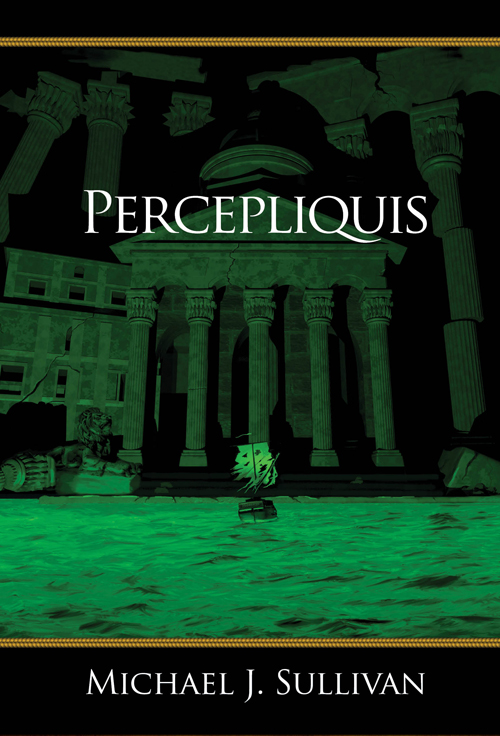
Percepliquis Cover


When I started releasing my books I pretended that there were crowds of people interested in them. I wrote blogs to the effect, as if I was actually holding a midnight release party where poor fans waited in cold April rains for the doors to open at Amazon. The reality was, back when I was releasing Avempartha, no one really knew, or cared. I didn't think much had changed until the explosion that followed the news about the delay of the final book. Since then I have started to realize that maybe there really are people waiting for the next book. Of course, this isn’t just the next book—Percepliquis is the last book.

Percepliquis is my personal favorite of the series, my chance to finally cut the restraints off myself and the characters, and let them run free for the first time—to let them live up to their full potential.

I know that those of you who have been with me from the beginning have waited a long time. I know of a few fans and old friends who read the first four books as early as 2007, and are still waiting for the conclusion. And while you still have a little more than five months to wait, I wanted to give you a peek. As with every book since Avempartha, I have unveiled the cover here.  Today I present to you Percepliquis, the final cover of The Riyria Revelations. (Concept, art, and design by me)


It All Comes Down To This
The Elves Have Crossed the Nidwalden
And Two Thieves will decide the Future


I saw a great journey. Ten upon the road, she who wears the light will lead the way. The road goes deep into the earth, and into despair. The voices of the dead guide your steps. You walk back in time. The three-thousand-year battle begins again. Cold grips the world, death comes to all, and a choice is before you.

Percepliquis is the final installment of the epic fantasy, The Riyria Revelations.  In this saga that began with The Crown Conspiracy, two thieves caught in the right place at the wrong time were launched on a series of ever escalating adventures that have all lead to this moment. Three thousand years have passed and the time for Novron’s heir to act has arrived.

January 2012

For those of you who want to be reminded when this book becomes available whether in ebook or print, click here.

Sunday, June 26, 2011

Writing Advice 2: Before the Basics


This is the second in a series of posts designed to assist new aspiring writers learn the craft. You more experienced writers (published or not,) Please feel free to comment on anything you think I might have missed. This is the first day of class where we aren’t going to get any work done, but you’ll get your supply list.

So what do you need to be a writer? A pencil and paper is the basic answer, and it is sort of true, but if you plan on getting published as a writer, you’re going to need more, and this brings me to my first clarification issue (there will be a lot of these.)

WHAT IS A WRITER?
This tends to be a hotly debated topic, and generally reduced to the opinion of the person defining it, and where they happen to be in their career at the time. Most concede that there are ranks, or at least different flavors of writers. How these levels are delineated again drifts in a sea of personal opinion because unlike non-creative careers, fiction writing lacks objective benchmarks. In the United States you can’t practice medicine without first obtaining a license, and you can’t obtain a license without first obtaining a medical degree, so these are looked upon as steps that identify how far along you are in your career. Creative writing doesn’t work that way, although many people think it should (particularly those with degrees.) When you’re talking anything in the realm of the arts it is like entering a nebula in a science fiction movie, nothing seems to work like it’s supposed to. You can be successful with no training at all, and you can hold PhDs in all things literary and never succeed.

But what is a writer?

a) a writer is someone who writes, meaning they enjoy writing and do a lot of it.
b) a writer is someone seriously working to make writing their career
c) a writer is someone who is published
d) a writer is someone who has been vetted by the industry
e) a writer is someone who is supporting themselves entirely by their writing

For most people a writer is whichever one of these you happen to be, or if you are insecure, it is the next one up. However, for the purpose of these posts, I am adding two new definitions.

Newbie aspiring writer: those who would like to one day make a living (or at least money) as an author.
Veteran Aspiring Writer: those who’ve been at this a while and still have yet to break into the industry in any significant way.

Most of my comments will be directed at these two groups of writers, the career oriented--the AP students. 

Now, getting back to what you need, if you try and send a manuscript to a publisher written in pencil, they won’t be too happy. Times have changed. Almost everything is done by word processor and email these days, although I was surprised when my publisher asked if I was comfortable receiving edits from them digitally, and if I wasn’t they would send me a printed hard copy. Seriously? Authors still use hard copies?

WORD PROCESSOR
So, to start you will need a computer and a word processor. If you are on a Windows machine I would suggest Microsoft Word, if you can afford it. It usually costs about $200. This is what I use. If you don’t have the money, you can use Google Docs which provides you with a free word processor service that is compatible with Word and gives you free cloud access (which I will talk about more in a second) or download OpenOffice, which is also a completely free software package that is similar, and compatible with, Microsoft Office. OpenOffice is available for Macs as well. Of course if you’re on a Mac you might want to check out Scrivener which tends to be the leading writer’s software on that platform. There is a Windows version, which is very good, and I talk more about in detail here. And if you’re planning to work on an iPad: Pages is the Apple app for word processing on the iPad and provides all the usual abilities. I also like iAWrite, it doesn’t have all the bells and whistles but it is tailored a bit more for writers. It provides easier access to quotes, apostrophes, and other typically used keys, but mostly it provides the all important and oddly often missing, ability to move the cursor back and forth with the keyboard.

There are also a number of other lesser known programs designed for writers, but I would like to warn you that some of these programs offer so much in the way of options and features that they can become a time-sink in themselves. Writers often have trouble staying on task as it is and you really don’t need any more distraction. When you realize that until very recently, (yes I’m that old) writers all used typewriters, or pen and paper, and did just fine. All the bells and whistles of some of these programs look like toys for people who aren’t really serious about writing. All you actually need is a basic word processor.

INTERNET ACCESS
When I started writing the Internet did not yet exist and research was a career unto itself. Finding the answers to the simplest of questions could take months and require traveling and awkward interviews. Having access to a web browser is like putting away your scrub board and lye soap to make room for the electric washer and dryer. The speed and accuracy of writing improved astronomically.

NOTEBOOK
Something else that I found useful are notebooks. Being at least a little pretentious I prefer the famous Moleskin notebooks that you can find in art stores or your local Barnes & Noble. Moleskin notebooks have been around since the 19th century and were used by artists and writers from Van Gogh to Hemmingway. They come in a few varieties and the package label is color coded to help tell the difference. Some are blank, some are lined, and some are quad-lined like graph paper. They also come in small, medium, and large. These notebooks aren’t fancy. They are the model-T of notebooks, almost always basic black. They are however very durable and very usable in that they have good stiff covers, (allowing them to be written on no matter where you are,) and stitched bindings (that allow them to lay flat on a table,) and take a lot of abuse without breaking or loosing pages. Unfortunately they are also surprisingly expensive, costing around twenty dollars for the medium size (5x8) which I use (large enough to write in comfortably and small enough to carry just about anywhere.) In reality, any notebook, or even a pad will do.

Why use a notebook if you have a laptop or an iPad?

1) Portability and ease of use. I’ve begun doing on-site research for my new novel, which means I go to places and take notes. In a coffee shop it is easy to sit down and fire up a laptop, but it doesn’t work so well if you’re standing up in a store interviewing someone, (and it is hard to both hold and type on an iPad, but I suppose you could take thumb notes on a smartphone) wandering around a crowded city, or riding a bike. You could use recording software, but I find that annoying as I can’t browse through my notes and people shy away from being recorded. There is software that will convert verbal to text, but that’s a lot of effort to go through when you can just use a notebook. A tablet can also be used for this, but they are not quite as rough-and-tumble, and there is another reason I find them inadequate to the task, which I will get to.

2) It allows you to sketch as well as write. You can draw out maps, and diagrams of things you want to use later, or do drawings of places or people, as they appear to you.

3) Mostly however, the reason I use them is for brainstorming. I don’t write prose in notebooks. I write my books on my tower computer locked in the sanctuary of my office with the door closed and the rest of the world, and its distractions, walled off. This is how I focus. When I am writing on my computer I ponder the choice of words. I evaluate the structure of sentences and the build of paragraphs. I try and avoid misspellings and bad grammar even on my first drafts. And were I to take a laptop, or even a tablet to a coffee shop, I would try and do the same and be frustrated by all the distractions.

However, when I use a notebook, when I am writing long-hand using a nice fountain pen, I’m not working on something that could even remotely be used as a finished product. It’s in a book, and written in pen. Nothing I write there can be used as is. Knowing this frees me to not focus on the words, but to think only about the ideas. The noise of conversation, the honk of horns, and the background music blends into static that my mind can ride on as I day-dream. If I were to try this in the isolation of my office, I’d get sleepy. In a busy coffee shop or roadside cafĂ©, the activity keeps me alert, (not to mention the coffee,) but as none of it requires my attention I can let my mind wander. Then when I put my pen to paper, thoughts focus. The first thing I write leads to another. Soon I am scribbling notations of a dozen random thoughts and drawing lines and arrows between them, crossing out some as better thoughts materialize. I’m not concerned about the words I’m using, just capturing random thoughts as they spill out. When I’m done, I usually have dozens of concepts listed that I will use as a resource when I sit down to write. A lot of the time I don’t need to look back at what I wrote, just having written it is enough to have helped me work through plot or character issues. But when I get stuck, or am delayed due to real-life issues and forget, I can look back and jolt my memory.

4) Posterity. A notebook forms a bit of history, insight into the making of a written piece. Should one day you write the great American novel, that little notebook might be worth something to the world. If not, it will still be worth something to you.  

PEN
Another thing I use, as mentioned, is a fountain pen. Why? Cause it’s cool. It makes writing a Victorian novelty and therefore fun. It also elevates cramping because you really don’t need to, and really can’t, press hard with a fountain pen. Most cost upwards of $60 but I found a very nice pen on Amazon for just over $20.

SOFTWARE
The best software I’ve found outside of a word processor is WordWeb, which is a free application that works as a dictionary and thesaurus. What makes it great is that it works in concert with anything. You merely control+right click on any word in any application and it launches WordWeb bringing up the definition and a small interface for finding a large variety of similar options. So whether I am using Word, or in a browser, I can check the definition of a word or see a dozen alternatives.Sadly this only works on Windows systems.

Google Earth is another useful program, although now it is integrated right into most online maps. What makes this so special is the street view feature you get when you zoom all the way in on a location. You see a 360 degree view of most areas as if you were standing there, at least where there is a major street. This is wonderful if you need to write a description of some place you’ve never seen.

CAMERA
A camera is extremely useful for recoding images that can be used later for reference. No matter how detailed a written description is I still find myself going back and looking at photos. Of course, cameras can’t record smells, sounds, or how it feels to be somewhere, so written notes are still important.

MUSIC
This is something I just happen to do. Total silence while writing, can become oppressive and yet just about any sounds can be distracting. Playing music in the background helps muffle everything else, but songs with words interfere with my writing. Classical music is better, but can sometimes be too dull, or inappropriate for certain scenes. When you are writing a high speed chase through Brooklyn, Vivaldi’s Four Seasons, might not be best. I found that scores from movies, not soundtracks (which are too often just a string of songs,) but the originally composed music, that often goes unheard in the background of scenes, are perfect. I have quite a few and created playlists with titles like: Action, Happy, Heroic, Ominous, and Sad. Then depending on the scene I am writing, I play the appropriate list and it can help put me in that mindset the same way the music was designed to put the audience in that mindset.   

For those aspiring writers who can’t afford to purchase dozens of movie scores, or classical performances, you can always use Pandora, which you can download for free. By entering in the name of a movie score composer, or classical artist, it will play similar music for you.

TABLETS & E-READERS
This is of course very optional and can be replaced with a printer, but is better if you can afford it. Every time you read your own work in a different format, you will look at it with fresh eyes. If you write on a computer, and then print what you wrote and read it in another room, you will notice mistakes you never saw before. I think this is due to how the mind perceives things differently under different circumstances. Likewise, if you read your work aloud, you will find other issues, and if someone else reads to you, you will find still more. Mostly however, I’ve found that when you read your work in a setting that is most similar to how you normally read books by other authors, you will find yourself seeing mistakes far more easily. As such, if you read books on an e-reader or tablet, or even a phone, then importing your book to that format and reading it, will often help you better evaluate it as well as find typos. You can achieve the same effect by printing the story and taking it to the couch or bed to read, but then you run into the cost, time, and effort of printing your work over and over. With a tablet you can just email your writing to yourself, Skype it, use a cloud, or a number of apps that allow for simple drag and drop file sharing.

CLOUDS
The Cloud is almost another name for the Internet. If you have Gmail or Yahoo mail, you are using a cloud. A cloud is when you upload and store information on the Net. This is a fairly new and emerging commercial technology, and as such there are several. What it means for a writer is that you can upload the draft of your novel and then access it using any device that has access to it such as your iPad, your laptop, your desktop, your smart phone, or even your friend’s computer.

More than granting you the ability to access your work across platforms, it also works as a backup. I know authors who have lost whole novels when their computers caught a virus and died. There are few things more defeating than losing the only draft of a book. Keeping an updated draft on a cloud means that if your computer is wiped, stolen, or lost, you still have a digital copy you can download to your new computer. Even if your home burns down, and your computer, your HD backup, and all your printed and stored DVD copies are destroyed, you’ll still have the cloud copy. And again it is so much easier to drag and drop a file than to re-print a hard copy or insert and burn a DVD.

Another benefit is collaboration. If you are working with someone else, you can use cloud apps like Google Docs to work on the same manuscript in real time with someone else, so they can see your changes as you make them. And Word and other documents can be uploaded to Google Doc, by just drag and drop, assuming you are using Chrome or Firefox

Most cloud apps are free up to a certain amount of memory usage. Since more people use clouds for photos or music, and since text files are tiny in comparison, you should be able to use cloud technology for all your stories and never hit the max memory usage.

BACKUP
You need a way to backup your work. Never have only one copy of your book or short story, and never keep all the copies of your work on one computer. If you get hit by a virus and your computer dies, you just lost everything. I personally keep many backups in a variety of forms. I burn DVDs of completed drafts and final manuscripts. I have printed copies. I have a massive external hard drive that keeps a mirror image of my entire computer on it. And I keep copies of my works in progress in clouds. So be sure to have some means of making a copy of your work that is not on your computer, just in case.

So this is your list of supplies. Come back next week for your first real class, which will be titled: Outlining. Have a good day and remember not to run in the halls.   


Tuesday, June 21, 2011

End of an Era…at least for me


The original self-published versions of the Riyria Revelations will soon be retired. The rights to the series are about to be transferred to Orbit which means the Ridan versions will be discontinued.

Print books are being discontinued first. The Crown Conspiracy will be off the market in perhaps as little as a week. The rest of the print books will be phased out by the end of July. Ebooks will be phased out and completely off the market by the end of August.

Percepliquis, the final book in the series, will be released in January to complete the set of six. I will be revealing the cover art for this final book here on this blog next week.  

For those of you who read my little books when no one else would--and you know who you are--thanks. In case you didn’t know, Robin and I did all the work on those ourselves. Robin handled the editing, and I did the cover art, the design art, and the book layouts right down to picking the same font that was used in the Harry Potter books, because we found that to be the most attractive and readable. In a strange kind of way, you could almost say they were handmade, at least they felt that way, and I hope you enjoyed the books as much as I enjoyed making them.

Sunday, June 19, 2011

Writing Advice


I’ve shied away from writing posts on how to write even though I am aware that a sizable section of my audience is likely aspiring writers and might appreciate some insight or at least validation. The reason I’ve avoided such topics is that I don’t know how to write. Let me clarify—I’ve never “learned” how to write in any structured sense.

I never had any formal education beyond the one Creative Writing class in my sophomore year of high school, where I and two of my friends terrorized our teacher by turning Mother Goose rhymes into gritty urban satires. This sort of cutting edge inventiveness might succeed in later life, but doesn’t play well in suburban classrooms. In that same class I did achieve my first serious notoriety. The assignment was to write a short story (two pages) about a photograph of a flower. I penned a story about a boy sent topside from the bunker where the last of humanity was trying to survive a nuclear holocaust. His job was to search for signs of life, but the boy was of a generation born in the bunker. When he stumbled on the flower he plucked and discarded it thinking: how could anything so fragile hope to survive in such a world as theirs. The teacher read the story in front of the class, and when the teacher revealed that I wrote it, the best writer in our class--a girl by the name of Megan--was unable to control herself and said in utter shock, “A boy wrote that?”

Beyond this, I have had no formal training. I only attended a little over a year of college at an art school, where they did not even teach English much less writing. I never read a book on how to write, or attended a seminar. And not only had I not visited a writing group until after I was published, I never talked to another writer—not even a remotely aspiring one. I had spent a decade earnestly trying to learn to write in a total vacuum.

It was not until I signed with Catt,  my first agent, who had agreed to represent The Crown Conspiracy, that I began to discover how much I didn’t know. She politely mentioned a problem with my point of view and sweetly indicated that there were a couple of places where I was telling and not showing. I had never even heard of these terms before. For those of you who aren’t in the business of writing, these are some of the first things a writer learns if he/she is attending workshops or classes. It turned out I was trying to do calculus without even knowing what addition and subtraction was.

Later, about the time Avempartha was being published, my wife got me into a seminar at George Washington University. It was headed by Mary Morrissy, the award winning Irish author of Mother of Pearl.  On occasion, after class a few of us would join her at one of the tiny Georgetown pubs and chat while we watched people pass by the window. Upon learning that I was already published Mary asked why I was in the class. I replied that I was there because I never learned to write in any formal way. To this she replied, “That’s probably why you’re successful.”

So you see from my experience I don’t see I have all that much to offer. Besides the concept of giving advice on how to go about writing strikes me as a bit arrogant, pretentious, and fairly stupid as no two writers, or approaches, are alike, nor should they be. There is an infinite number of reader’s preferences and as such there should be an equal amount of literary variety to service them. Probably the best advice I can give a writer, is not to listen to anyone’s advice. There are many books I would have deemed unpublishable, or incapable of gaining an audience, which have won the Pulitzer or reaped fortunes for the author. I’m certain I am not alone in my ignorance of what will and won’t be successful. Advice-givers can only speak about their opinions, about what they feel works best, and this might only work for them. Granted there are some universally accepted rules, but even those can be successfully broken.

On the other hand, I am frequently asked for advice about writing. I could tell everyone what I just told you and leave it at that, but this strikes me as a miserably screw-it-forward attitude. It isn’t so much that I don’t want to offer suggestions, it is merely that I have no idea if my currency of thought will have value for anyone else, and I’d hate to derail anyone on the track to greatness by indicating that what they are doing is wrong and having them listen to me.

On my third hand, everyone has to start somewhere, and fearing that a writer will be ruined by listening to my advice is in itself awfully arrogant. It suggests that people aren’t capable of thinking for themselves and determining on their own, the merit of another’s advice.

My wife is a great substantive editor. She has a logical, detail-oriented, engineering type mind. She also has a strong personality and isn’t afraid of debating a character, or plot point even with the guy who invented the world and all the people in it. I can imagine Robin critiquing God on platypuses. “Seriously? You’re going to put this in? You don’t think it’s a little…I don’t know…stupid? Com’on a mammal that lays eggs? That’s inconsistent with everything else you created. I know you love it, but come on. It’s bizarre—an egg-laying, venomous, duck-billed, beaver-tailed, otter-footed mammal? There’s no way that stays in.”

After Robin rips my book apart, I sit down and determine whether to accept her advice or not. In the end it is always my decision. (The other thing that makes Robin a great editor, is that she accepts it when I reject her ideas without asking for a divorce.)

The best I can do then is offer what I’ve learned and you can decide for yourself if you think it’s useful. In so doing, there is the chance I might provide someone with that missing piece they’ve been needing. As such--and this has been quite the preamble--I will begin offering what wisdom I have on how to write novels in a series of posts that I will try and write once a week. We’ll see how that goes.

In the meantime, here is the first bit of advice that plays into the bit about Robin helping me with my books. When you receive advice on a manuscript, don’t make a decision. Initially all critiques are grating. No matter how nicely delivered, hearing criticism is painful. Most people become defensive. They want to stand up for themselves and explain why it has to be that way, and what the reader clearly missed. I’ve learned that if you get defensive with people giving you honest critiques, you won’t get them anymore. So controlling that reflex is important.

The other thing I found is to wait. I’ve gotten into long running debates with Robin about parts of my books. I argue with her over my work (something I only do with her, because I know she’s capable of standing up to it) I even get angry, though I try to hide it. I defend my stance and have often won the arguments. Then the next day I sit down at my computer. When I’m alone with my thoughts and no one can see, I reevaluate. The anger is gone, the embarrassment, and pride are all someplace else, and it is just me alone with the decision. Most of the time I realize she was right and I quietly make the change.

Robin will then be proof reading the passage and stop. “Hey, I thought you weren’t going to change this?”

“Change what?”

“What do you mean, what? We argued over this for hours. The neighbors almost called the cops. Why’d you change it?”

“I have no idea what you’re talking about, it’s always been that way.”

I might have gotten away with it if she hadn’t saved the previous copies on her computer.

So getting honest advice is a rare gift. Being able to determine whether to accept it or not is priceless. And getting away with making it look like it was your own idea all along, just doesn’t work.

Stay tuned for more writing tips and if you have any specific questions, things you don’t understand, things that you have problems with, or are just curious about, let me know. I may not know the answers, but I lie real well.